
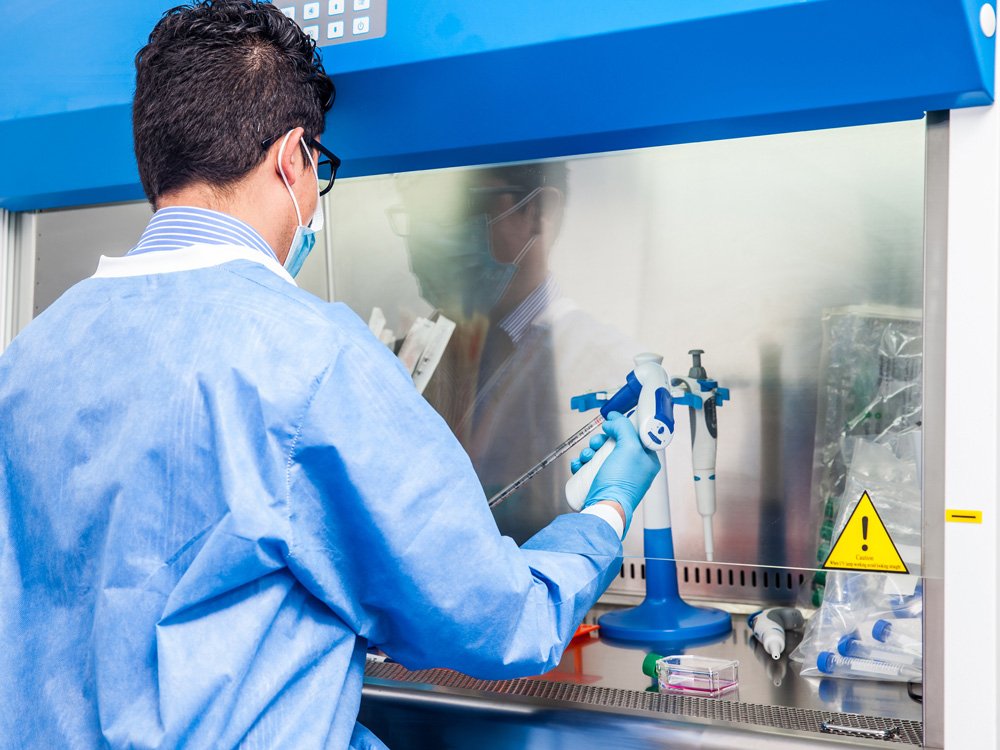
NEBB-credentialed testing, adjusting, and balancing for hospital cleanrooms, pharmacy compounding suites, isolation rooms, operating rooms, sterile processing, and cGMP manufacturing facilities. Joint Commission TAB documentation for Environment of Care surveys. Delivered by Precision Biotech Solutions, an Allometrics Group company.
A2LA Cert 2039.01 · ISO/IEC 17025 calibration · valid through April 2027 · A2LA Cert 7533.01 · Taylor Lake Laboratories biological testing · valid through September 2027 · Founded 1976 · 1,800+ accounts · Texas · Louisiana · Mississippi · Alabama · Florida · Los Angeles metro · nationwide field service
When the cleanroom drifts, balance restores compliance
Cleanrooms and regulated clinical spaces are in continuous motion. HEPA filters load. HVAC dampers shift. New equipment changes the airflow pattern. A pass-through gets added in a renovation. Operational density rises. Door gaskets wear. Each change moves the air balance away from where it was at commissioning. None of these changes is dramatic enough to shut the room down — and that's exactly the problem. The room continues running until a recertification flags it, an inspector questions it, or a viables excursion exposes it.
Air balancing is the corrective service that restores the room to design specification. Testing, Adjusting, and Balancing — TAB — is the engineering discipline that measures the actual airflow performance of the HVAC system and adjusts it back to design intent. It is performed by NEBB-credentialed technicians using calibrated instrumentation, with documented reports formatted to satisfy USP, FDA, Joint Commission, and ASHRAE Standard 170 requirements.
Precision Biotech Solutions is the Allometrics Group company that handles the TAB work. NEBB-credentialed technicians. ASHRAE 170-aligned methodology. Documentation that passes Environment of Care surveys, FDA cGMP inspections, and state board of pharmacy reviews on the day of issue.
"Each ventilated room and air-handling unit shall be tested, adjusted, and balanced to the design conditions, with documented results retained as part of the facility's permanent record."
— ANSI/ASHRAE Standard 111 (paraphrased)
What PBS air balancing services include
A complete TAB engagement addresses every parameter that defines whether the ventilation system is performing as designed. PBS delivers each of these with NEBB-credentialed technicians and calibrated instruments traceable to NIST under A2LA Cert 2039.01.
HVAC system balance. Verify supply CFM, return CFM, exhaust CFM, and outside-air percentage at every air handling unit. Adjust dampers, fan speeds, and terminal devices so each space achieves its design airflow. Reconcile the as-built system against the design drawings.
Air change rate verification and adjustment. Confirm that each cleanroom, buffer room, ante-room, and clinical space achieves its required air change rate. ISO Class 5 PECs typically need 240+ air changes per hour; ISO Class 7 buffer rooms 60+; ISO Class 8 ante-rooms 20+. Hospital clinical spaces follow ASHRAE Standard 170 — operating rooms 20+ ACPH, AIIR rooms 12+ ACPH at negative pressure, protective environment rooms 12+ ACPH at positive pressure.
Pressure cascade verification and adjustment. Map the pressure relationships across the regulated suite. Positive cascades for sterile compounding (USP <797>): cleanroom positive to ante-room, ante-room positive to corridor. Negative cascades for hazardous drug compounding (USP <800>): negative buffer room, negative storage. Negative cascades for infectious disease isolation (AIIR): negative patient room, negative anteroom. Adjust dampers and offset air to restore each cascade.
Terminal device adjustment. Variable air volume (VAV) box calibration, constant volume box adjustment, supply diffuser balancing, return / exhaust grille adjustment.
HVAC equipment performance verification. Fan curve verification, motor amp draw, static pressure profile across air handlers, coil performance under design load.
Documentation. A signed TAB report formatted to NEBB protocols, with all measurements, calibration certificates for the test instruments, methodology references, and a clear pass / fail / conditional disposition on every parameter. Reports delivered in your facility's required format and ready for inspector or surveyor review.
Joint Commission TAB for hospital systems
For hospital pharmacy departments, surgical suites, isolation rooms, sterile processing departments, and any other regulated controlled environment within a Joint Commission-accredited hospital, current TAB documentation is part of the Environment of Care (EC) and Life Safety (LS) chapters. Surveyors expect signed, current TAB reports for any space with engineered ventilation requirements.
PBS provides Joint Commission-aligned TAB services covering:
- Pharmacy IV rooms and hazardous drug compounding suites — USP <797> / <800> aligned, with documented positive cascade for sterile spaces and negative cascade for hazardous drug spaces.
- Operating rooms — ASHRAE 170 positive pressure, 20+ ACPH at design conditions, 100% outside air or compliant make-up.
- Airborne Infection Isolation Rooms (AIIRs) — ASHRAE 170 negative pressure relative to corridor, 12+ ACPH, exhaust direct to outside.
- Protective Environment (PE) rooms for immunocompromised patients — ASHRAE 170 positive pressure, 12+ ACPH, HEPA-filtered supply.
- Combination AIIR/PE rooms with anteroom — most demanding configuration; both isolation and protection requirements simultaneously.
- Bronchoscopy rooms and other procedure rooms with engineered ventilation.
- Decontamination and sterile processing department air balance per AAMI ST79.
- Compounding cleanrooms aligned to USP <797>, <800>, and <825>.
For multi-facility hospital systems, PBS coordinates TAB scheduling across campuses and produces consolidated documentation that the system's accreditation team presents as a single deliverable for Joint Commission EC and LS reviews.
USP <797>, <800>, and <825> pharmacy compounding TAB
For compounding pharmacies — hospital, independent, 503A, 503B, and radiopharmaceutical — air balance is the parameter that determines whether the cleanroom achieves its USP-required pressure cascade and air change rate. A pharmacy buffer room that is no longer maintaining positive pressure relative to the ante-room is not USP <797> compliant regardless of how clean the surfaces are. A hazardous drug compounding room that has lost negative pressure to the corridor is not USP <800> compliant regardless of CACI containment.
PBS air balancing for pharmacy compounding facilities specifically addresses:
- USP <797> Category 1, 2, and 3 cleanroom air change rates — each Category has different cleanroom requirements; PBS confirms the cleanroom's actual performance matches its declared Category.
- USP <797> pressure cascade — positive cleanroom to ante-room to corridor, with documented differentials in pascals or inches of water.
- USP <800> hazardous drug compounding pressure cascade — negative buffer room to negative storage to corridor, with containment verification.
- USP <825> radiopharmaceutical compounding — radiation-area-specific cascade requirements.
When viables data shows action-level excursions despite passing cleanroom certification, the diagnostic question is often air balance. PBS performs the TAB diagnostic, identifies the imbalance, restores the design cascade, and documents the corrective action — with results that reconcile against your viables and certification records.
Common scenarios that trigger air balancing
| Scenario | What's happening | What PBS does |
|---|---|---|
| Joint Commission survey approaching | EC / LS chapters require current TAB documentation | Pre-survey TAB engagement, consolidated report delivered before survey |
| USP <797> recertification fails or shows drift | Pressure cascade or ACPH out of spec | Diagnostic TAB, damper / VAV adjustment, re-verification |
| HVAC modification or equipment change | New equipment, ductwork change, AHU modification | Re-balance affected spaces and any rooms whose cascade is dependent on them |
| Recurring viables excursions in a cleanroom that "passes" certification | Air pattern issue not visible in particle count alone | Smoke study + TAB to identify and correct the airflow defect |
| Operational change — added shift, denser personnel, new procedure | System designed for a different load profile | Re-balance to current load |
| AIIR pressure alarm or door swing problems | Negative cascade not maintaining | Diagnostic, repair, re-balance, re-verify |
| Annual cleanroom recertification cycle | Recertification flags drift; TAB is the corrective service | Schedule TAB to follow recertification on the same site visit when scope warrants |
| Post-construction cleanroom reactivation | Facility put back into service after extended downtime | Full TAB as part of re-commissioning |
Frequency and scheduling
| Trigger | When | Notes |
|---|---|---|
| Annual minimum | Every 12 months for most regulated spaces | NEBB recommendation; Joint Commission EC expects current documentation |
| Pharmacy USP recertification cycle | Aligned to your USP <797> Category requirements | Often paired with annual cleanroom recertification |
| Post-modification | Before return to service | Any HVAC change, equipment change, ductwork modification |
| Post-equipment-failure | Before return to service | Fan failure, coil failure, control system fault |
| Pre-survey | 30–60 days before Joint Commission, FDA, or state board review | Lead time for any deficiency remediation |
| Continuous monitoring trigger | When BAS / monitoring system flags pressure or temperature deviation | On-demand response |
PBS service contracts include scheduled annual TAB plus on-demand response for unscheduled triggers. Multi-facility hospital systems can consolidate scheduling across all campuses into a single coordinated TAB program.
Why PBS — and the integrated Allometrics Group cleanroom lifecycle
PBS air balancing is one component of the integrated Allometrics Group cleanroom lifecycle. The same Group that calibrates your equipment under A2LA Cert 2039.01, certifies your cleanrooms and primary engineering controls under our Cleanroom Certification and BSC Certification services, and analyzes your viable samples through Taylor Lake Laboratories under A2LA Cert 7533.01, also balances the HVAC system that ties them all together.
That continuity is the moat. When recurring viables excursions don't have an obvious cause, the diagnostic question is rarely "is it the HEPA, the cleaning, or the personnel?" — it's all of those plus the air balance, the cleanroom envelope, the surrounding rooms' cascades, and the equipment placement. Most facilities have to coordinate that diagnosis across three or four separate vendors. The Allometrics Group does it in one organization with one shared data set.
For new cleanroom construction or major renovations, PBS also performs full cleanroom commissioning — initial qualification, IQ/OQ/PQ, ISO 14644 classification verification. The same NEBB-credentialed team that handles your ongoing TAB work qualified the cleanroom at startup.
A2LA Cert 2039.01 · ISO/IEC 17025 calibration · valid through April 2027 · A2LA Cert 7533.01 · Taylor Lake Laboratories biological testing · valid through September 2027 · Founded 1976 · 1,800+ accounts · Texas · Louisiana · Mississippi · Alabama · Florida · Los Angeles metro · nationwide field service