
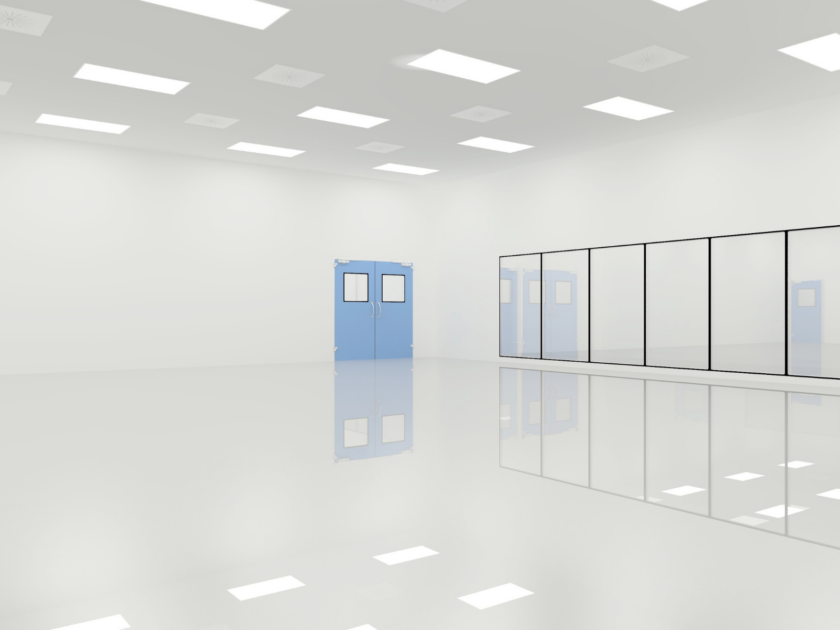
For facility managers, plant operations leaders, hospital construction teams, and pharmacy directors qualifying a new or renovated cleanroom under USP <797>, USP <800>, ISO 14644, FDA cGMP, or Joint Commission requirements. Delivered by Precision Biotech Solutions, an Allometrics Group company.
A2LA Cert 2039.01 · ISO/IEC 17025 calibration · valid through April 2027 · A2LA Cert 7533.01 · Taylor Lake Laboratories biological testing · valid through September 2027 · Founded 1976 · 1,800+ accounts · Texas · Louisiana · Mississippi · Alabama · Florida · Los Angeles metro · nationwide field service
Commissioning is where compliance actually starts
A cleanroom is not certified until it is commissioned. The contractor builds the physical structure to specification — walls, ceiling grid, HVAC ductwork, HEPA modules, control system. Construction tells you what was installed. Commissioning tells you whether what was installed performs the way the design said it would.
The distinction matters because every downstream compliance obligation — your annual cleanroom recertification, your USP <797> environmental monitoring program, your Joint Commission accreditation, your FDA cGMP qualification — depends on commissioning data. Without a valid Installation Qualification (IQ), Operational Qualification (OQ), and Performance Qualification (PQ) package, the cleanroom is in service but not yet defensible. A surveyor or auditor who asks for IQ/OQ/PQ documentation should receive it the same day, with cert numbers and traceable measurements.
That is the work Precision Biotech Solutions delivers. PBS is the Allometrics Group company that handles the validation step between construction and ongoing certification. NEBB-credentialed TAB. Pressure-cascade mapping. HEPA leak testing. ISO 14644 classification verification. Documentation that satisfies USP, FDA, and Joint Commission standards on day one.
"Cleanroom and clean zone classification shall be performed in the Built, At-rest, or Operational state, and the test reports shall include all data needed to verify conformity to the requirements."
— ISO 14644-1:2015, Section 5
What cleanroom commissioning includes
A complete commissioning package addresses every parameter the cleanroom is required to maintain in service. PBS delivers each of these as part of the IQ/OQ/PQ scope, with documented test methods, calibrated instruments traceable to NIST under A2LA Cert 2039.01, and signed reports formatted to your facility's quality manual.
HVAC system startup and balance. Verify that the air handling unit performs to design — supply CFM, return CFM, exhaust CFM, outside air percentage. Adjust dampers and balance the system so each space reaches its design air change rate. NEBB-credentialed TAB technicians perform the balance work and produce the signed TAB report.
Air change rate verification. ISO 14644-3 method. Confirm that each room achieves the air change rate required by its ISO classification (typically 60+ air changes per hour for ISO Class 5 / Class 7 buffer rooms; lower for Class 8 ante-rooms; higher still for hazardous drug containment under USP <800>).
Pressure cascade mapping. Verify positive-to-positive room differentials for sterile compounding spaces and negative-to-positive differentials for hazardous drug compounding under USP <800>. Document each room-to-room differential in pascals or inches of water, with calibrated manometers, traceable to NIST.
HEPA filter integrity testing. DOP or PAO challenge testing per IEST-RP-CC034 of every HEPA filter — supply HEPAs, return HEPAs, and any inline filtration. Identify and document any leaks, retest after repair, and produce signed certificates per filter.
Particle count testing for ISO 14644-1 classification. Sample air at the prescribed sampling locations and count particles at 0.5 µm and 5 µm. Compare to ISO classification thresholds. Issue ISO classification certificate (At-rest and / or Operational state) per the qualification protocol.
Recovery testing. Per ISO 14644-3 — measure how quickly the cleanroom returns to its target classification after a controlled particle challenge. Verifies that the air change rate is sufficient to maintain spec under operational disturbance.
Temperature and relative humidity qualification. Confirm that the cleanroom holds within design tolerances across a 24- or 72-hour window. Required for both USP <797> compliance (sterility-affecting parameters) and FDA cGMP qualification (manufacturing environment controls).
Dynamic smoke studies. Visualization of unidirectional airflow inside primary engineering controls (PECs) and across the boundary between PEC and surrounding cleanroom (ISO Class 5 in ISO Class 7). Required under USP <797> as proof that airflow patterns behave the way the design assumes. PBS produces video documentation along with written observation reports.
Documentation package. Every test result, every calibration certificate, every signed report compiled into a single qualification package — IQ documenting installed equipment and as-built drawings, OQ documenting performance under operational conditions, PQ documenting sustained performance over the qualification window. Delivered in your facility's required format (paper, electronic, validated PDF).
ISO 14644 classification verification
PBS qualifies cleanrooms across the full ISO 14644-1 classification range:
| ISO class | Particle limit (≥0.5 µm/m³) | Typical use cases |
|---|---|---|
| ISO Class 5 | 3,520 | USP <797> primary engineering controls; cGMP aseptic processing (Grade A / B); sterile fill |
| ISO Class 7 | 352,000 | USP <797> buffer rooms; cGMP Grade C; cell & gene therapy production |
| ISO Class 8 | 3,520,000 | USP <797> ante-rooms; cGMP Grade D; bulk pharmaceutical compounding |
Classification is performed At-rest (the cleanroom is built and operating but unoccupied) and / or Operational (the cleanroom is staffed and running production), depending on the qualification scope. PBS reports both states where the protocol calls for it. The classification certificate becomes part of the cleanroom's permanent compliance record.
Joint Commission TAB support for hospital systems
For hospital pharmacy departments, surgical suites, isolation rooms, and any other regulated controlled environment within a Joint Commission-accredited hospital, TAB documentation is part of the Environment of Care (EC) and Life Safety (LS) chapters. Surveyors expect current, signed TAB reports for any space with engineered ventilation requirements.
PBS provides Joint Commission-aligned TAB services covering:
- Pharmacy IV rooms and hazardous drug compounding suites
- Operating room positive-pressure verification
- Isolation room negative-pressure verification (airborne infection isolation rooms / AIIRs)
- Protective environment rooms for immunocompromised patients
- Bronchoscopy rooms and other procedure rooms with ventilation requirements
- Decontamination and sterile processing department air balance
- Compounding cleanrooms aligned to USP <797> and USP <800>
The TAB report PBS produces is formatted to support both Joint Commission survey readiness and ASHRAE Standard 170 conformance. Signed by NEBB-credentialed technicians, traceable to calibrated instrumentation, delivered in time for survey preparation.
For multi-facility hospital systems, PBS coordinates TAB scheduling across campuses and produces a consolidated documentation package that the system's accreditation team can present as a single deliverable.
Why PBS — and why integrated with the Allometrics Group
A standalone commissioning agent gives you a commissioning package. The Allometrics Group gives you the same package plus everything that has to happen after.
When PBS commissions your cleanroom, the calibrated instruments used to perform the work are traceable to A2LA Cert 2039.01 — Allometrics' own calibration accreditation. When the cleanroom enters service, Allometrics' field service team is the one performing your annual or semi-annual recertification — using the commissioning data as the baseline and tracking drift over time. When viable air, surface, or fingertip samples are collected from your cleanroom under your USP <797> environmental monitoring program, they go to Taylor Lake Laboratories under A2LA Cert 7533.01 for accredited microbial testing.
That continuity is hard to replicate. Most commissioning agents hand you a package and disappear; the recertification vendor and the microbiology vendor never see the original IQ/OQ/PQ data. When a deviation occurs three years later, no one can compare current performance to baseline because no one held both data sets. Inside the Allometrics Group, the data set is one continuous record — owned by the same organization, traceable to the same accreditation chain, available to the same field-service team.
That is the integrated stack. One Group, three accreditation chains, end-to-end coverage from commissioning through the lifetime of the cleanroom.
When to engage PBS
The earlier the better. PBS adds the most value when engaged during the design phase rather than after construction is complete. A commissioning agent who reviews the design documents catches HVAC, pressure cascade, and HEPA placement issues that are expensive to fix after construction. Most engagements follow one of three patterns:
New cleanroom build. PBS engaged during design review (typically 30–90 days before HVAC startup), then on-site for startup, balance, and qualification. Final IQ/OQ/PQ package delivered before the cleanroom enters service.
Cleanroom renovation or expansion. PBS engaged when the renovation scope is finalized, then on-site for re-commissioning of any space affected by the work. Re-qualification covers the changed area plus any spaces whose pressure cascades or air balance are affected by the change.
Acquired or repurposed facility. PBS engaged when an existing facility is being put back into compliant service after a use change, ownership change, or extended downtime. Full qualification effort, often combined with a deficiency remediation phase before the qualification can be completed.
PBS also supports facilities running a periodic re-qualification on a multi-year schedule — typically required by FDA cGMP for manufacturing facilities and by some pharmacy accreditation bodies for hospital and 503B compounding spaces.
What you receive
The commissioning engagement produces a single deliverable: a qualification documentation package the facility can hand to a USP <797> surveyor, a Joint Commission surveyor, an FDA investigator, or a state board of pharmacy inspector and have every reasonable question answered in the document set. Specifically:
- Signed TAB report with NEBB credential reference
- HEPA leak test certificates per filter
- ISO 14644-1 classification certificate (At-rest and / or Operational)
- Particle count test data with sampling plan and methodology
- Recovery test results
- Temperature / RH qualification data
- Dynamic smoke study video and observation report
- Pressure differential mapping report
- Calibration certificates for all test instruments (traceable under A2LA Cert 2039.01)
- IQ / OQ / PQ documentation in your required format
- Executive summary suitable for inspector or surveyor presentation
Where qualification reveals deficiencies, PBS documents the deficiency, recommends remediation (with an estimate or referral to the appropriate trade), and re-qualifies the affected scope after remediation. The qualification report distinguishes "passed at first qualification" from "passed after remediation" — the latter is fully compliant but is sometimes scrutinized differently by inspectors.
A2LA Cert 2039.01 · ISO/IEC 17025 calibration · valid through April 2027 · A2LA Cert 7533.01 · Taylor Lake Laboratories biological testing · valid through September 2027 · Founded 1976 · 1,800+ accounts · Texas · Louisiana · Mississippi · Alabama · Florida · Los Angeles metro · nationwide field service