
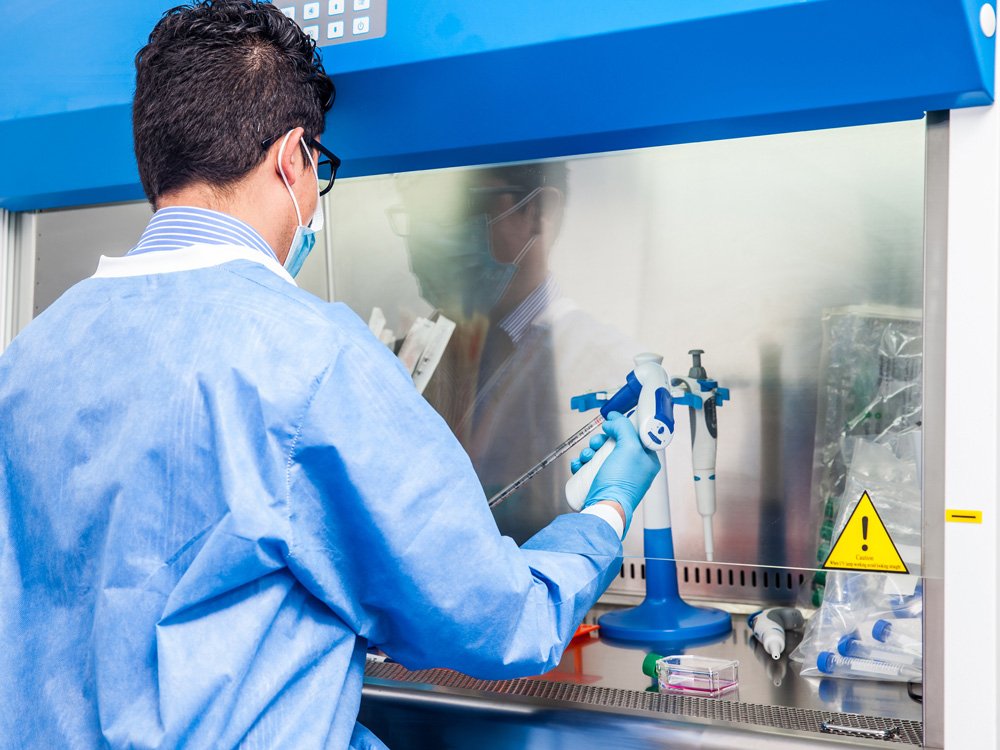
ANSI/ASSP Z9.5 certification, ASHRAE 110 performance testing, and preventive maintenance of laboratory chemical fume hoods. A2LA Cert 2039.01 ISO/IEC 17025 accredited. Five service tiers from basic certification through full ASHRAE 110 (AM / AI / AU) performance evaluations. Onsite service across Texas, Louisiana, Mississippi, Alabama, Florida, and the Los Angeles metro.
A2LA Cert 2039.01 · ISO/IEC 17025 calibration · valid through April 2027 · A2LA Cert 7533.01 · Taylor Lake Laboratories biological testing · valid through September 2027 · Founded 1976 · 1,800+ accounts · Texas · Louisiana · Mississippi · Alabama · Florida · Los Angeles metro · nationwide field service
Every quality assurance manager and lab director knows the anxiety that comes before an audit
Will your chemical fume hood certifications pass? Is your paperwork complete? What happens if equipment fails during important work?
Since 1976, Allometrics has provided chemical fume hood service across the Southern U.S. with nationwide field-service availability. Our A2LA ISO/IEC 17025:2017 accreditation reflects our commitment to the highest metrology standards, and our ANSI/ASSP Z9.5 and ASHRAE 110 expertise ensures your hoods meet the performance requirements that keep your team safe and your facility compliant.
We serve drug manufacturers, hospital pharmacies, compounding pharmacies, research laboratories, chemical processors, biotechnology operations, and industrial facilities. Whether you manage one lab or multiple campuses, we deliver consistent service quality, audit-ready documentation, and the responsive communication you need. From routine annual certification through emergency response and full ASHRAE 110 performance evaluations of newly installed hoods, our experienced technicians understand what's at risk when fume hoods aren't performing properly.
What ANSI/ASSP Z9.5 certification actually verifies
ANSI/ASSP Z9.5 is the consensus laboratory ventilation standard for the United States. It establishes the minimum performance requirements for chemical fume hood operation: face velocity, containment, airflow visualization, and supporting engineering controls.
A Z9.5 certification confirms that your fume hood:
- Maintains adequate face velocity across the sash opening (typically 80–120 fpm depending on application and the design intent)
- Demonstrates proper containment under smoke visualization
- Has functioning airflow monitor and alarm system (if installed)
- Cabinet integrity is intact — no damaged sash, no exhaust restrictions, no improper modifications
- Meets the manufacturer's operational specifications
"Chemical fume hoods are the primary engineering control for protecting laboratory workers from hazardous chemical vapors. Hood performance shall be verified at installation, after relocation, after maintenance affecting performance, and at intervals not exceeding 12 months."
— ANSI/ASSP Z9.5-2022 (paraphrased)
The Z9.5 certification we issue is recognized by OSHA inspectors, USP <800> hazardous-drug program reviewers, FDA cGMP investigators, Joint Commission Environment of Care surveyors, and state health and safety agencies. Properly documented Z9.5 certification is the operational baseline for laboratory ventilation compliance.
ISO/IEC 17025:2017 calibration
Valid through April 30, 2027
A2LA · Cert 2039.01 · Allometrics, Inc. ISO/IEC 17025:2017 calibration Mass · dimensional · pressure · temperature · electrical · volumetric · environmental Valid through April 30, 2027
Chemical fume hood types we service
Our technicians are trained to certify all types of chemical fume hood configurations found in modern laboratories and industrial facilities. We service equipment from all major manufacturers and understand the certification requirements specific to each design.
By airflow system
- Constant Air Volume (CAV) hoods — standard and bypass configurations
- Variable Air Volume (VAV) hoods — modulating exhaust controls
- Auxiliary air hoods — make-up air systems
- Combination systems — integrating multiple airflow technologies
By configuration
- Bench-top fume hoods — standard laboratory installations
- Walk-in fume hoods — oversized equipment and large-scale processes
- Portable fume hoods — recirculating filtration systems
- Double-faced demonstration hoods — educational and training facilities
By sash design
- Vertically rising sash systems
- Horizontally sliding sash configurations
- Combination vertical and horizontal sash designs
- Automatic sash closer systems with obstruction sensing
Related ventilation equipment we also service
- Snorkel hoods — localized fume extraction at specific workstations
- Canopy hoods — heat and fume capture above equipment
- Specialty enclosures — ventilated weighing stations, ductless filtered enclosures, glove boxes (where applicable to fume hood scope)
ASHRAE 110 performance testing — what it is, when you need it
The ANSI/ASHRAE Standard 110 is the most recognized fume hood performance testing protocol in North America. The current edition is ASHRAE 110-2016, which superseded the 1995 edition with updated mannequin height (22" from work surface), required digital data collection, and refined test procedures based on three decades of committee experience.
Important distinction. ASHRAE 110 is a testing protocol, not a performance standard. There is no formal "pass / fail" — the standard documents how to measure performance, not what acceptable performance must be. Saying a hood "passes ASHRAE 110" is technically imprecise. The accurate phrasing is "using the ASHRAE 110 testing protocol, the hood demonstrated containment of [X] ppm at [Y] face velocity under [defined conditions]." Acceptance criteria typically come from organizations like SEFA (which sets ≤0.05 ppm AM / ≤0.10 ppm AI/AU as the "low velocity / high performance" benchmark), from the manufacturer's design specification, or from your facility's own quality program.
The three variants of ASHRAE 110
AM — As Manufactured. Performed in a controlled test lab environment under near-ideal conditions. Used by hood manufacturers for design qualification and to compare performance across hood models, brands, and configurations. AM testing tells you what the hood is capable of in a perfect world.
AI — As Installed. Performed in the actual unoccupied laboratory after the building has been balanced and all systems are in normal operation, but before any equipment or materials are placed inside the hood. AI testing tells you whether the hood is being given a fair chance to perform in your specific facility — whether the laboratory ventilation system, room air balance, supply diffuser placement, and pressure relationships are supporting hood operation correctly.
When AI test results differ significantly from AM results, the hood itself is rarely the problem. Industry experience suggests roughly 20% of AI/AM differentials trace to actual hood design or installation issues, 55% trace to laboratory design or operation issues (room air balance, supply diffuser placement, exhaust system loading), and 25% trace to user behavior or environmental factors. The hood is the interface — it cannot perform better than the laboratory ventilation system supports.
AU — As Used. Performed in the laboratory with the hood configured exactly as it is normally operated — equipment, materials, hot plates, agitators, and operator workflow patterns all in place. AU testing tells you whether actual usage matches the safe operating envelope.
What an ASHRAE 110 test includes
Each ASHRAE 110 evaluation by Allometrics covers three core test components plus a peripheral scan and a sash movement test:
1. Face velocity measurement. A grid pattern is constructed across the design hood opening. A calibrated anemometer takes 20 velocity readings per grid rectangle (one per second), and the average for each rectangle is recorded. The grid average becomes the documented face velocity. Cross-drafts measured 1.5 ft from the hood face must be ≤30 fpm. The anemometer is mounted on a stand (not handheld), and the technician stands well clear of the opening to avoid affecting flow.
2. Smoke visualization. Both small-volume (local) and large-volume challenges are performed. Smoke is released along the work surface, walls, sash, and outside the hood face to visualize airflow patterns. The standard categorizes airflow as "lazy" (smoke remains on work surface without smoothly flowing to back baffle), "reverse flow" (smoke moves toward the front of the hood), or normal (smoke smoothly drawn from release point toward the rear baffle). Documented airflow patterns and any escape routes are recorded.
3. Tracer gas containment (SF₆). Sulfur hexafluoride gas is released from an ejector at three positions inside the hood (left 12" from inside wall, center, right 12" from inside wall). A mannequin positioned at the hood face has a detector probe at the breathing zone (22" above work surface, 3" in front of sash). SF₆ concentration is measured in 5-minute intervals at 4 L/min flow. The hood's performance rating is the maximum positional control level across the three test positions, recorded as `AU yyy`, `AI yyy`, or `AM yyy` (where yyy is the control level in ppm). SF₆ is used because it is not naturally present in laboratories, is five times heavier than air, and behaves consistently — making it ideal for repeatable, attributable measurement.
Peripheral scan. With the mannequin removed, the detector probe traverses the entire perimeter of the hood opening at 1" distance, no faster than 3"/second. Concentrations above the instrument's minimum detection level are recorded with location.
Sash movement effect (SME) test. With the ejector running, the sash is opened and closed three times at approximately 1.5 ft/sec. The 45-second rolling average of tracer gas concentration is calculated. The maximum rolling average becomes the SME rating, recorded as `SME-AU yyy`, `SME-AI yyy`, or `SME-AM yyy`.
When ASHRAE 110 is required (vs. ANSI Z9.5 alone)
For most laboratories, annual ANSI/ASSP Z9.5 certification is the operational baseline — face velocity, smoke visualization, cabinet integrity, airflow monitor verification.
ASHRAE 110 is the gold standard and is genuinely recommended (and in some procurement specifications, required) for:
- Newly installed fume hoods — full AI ASHRAE 110 evaluation as part of facility commissioning before the hood enters service. Manufacturers generally require this; many facility quality programs require it.
- Hoods after major renovation or relocation — AI evaluation to confirm performance has not been degraded by changes to the room ventilation system.
- Hoods serving high-hazard work — where the consequence of containment failure is severe (carcinogens, acutely toxic compounds, sensitization risks, USP <800> hazardous drug compounding).
- Investigation of suspected performance issues — where users report symptoms of poor containment, AU evaluation can identify whether the issue is the hood, the lab, or the user.
- NIH-funded research facilities — many follow the NIH Fume Hood Testing Protocol, which uses ANSI/ASHRAE 110 as its baseline performance test.
If you are commissioning new fume hoods and only running annual Z9.5 certification, you may be missing a meaningful safety and compliance gap. Talk to us about adding ASHRAE 110 AI testing to your commissioning workflow.
Five-level certification program
Allometrics offers a tiered certification program designed to match your facility's specific operational, compliance, and risk profile.
Level 1: ANSI/ASSP Z9.5 Certification Only
- General cabinet integrity inspection
- Face velocity testing and certification
- Airflow visualization test (smoke)
- Inspection and adjustment (where necessary) of airflow monitor
- ANSI/ASSP Z9.5-compliant report
Best for: facilities operating under standard laboratory ventilation requirements, annual recertification cycle, no special accreditation requirement.
Level 2: ANSI/ASSP Z9.5 Certification with ISO/IEC 17025 Documentation
- Inspect general cabinet integrity
- Test and certify face velocity airflow
- Perform airflow visualization test
- Inspect and adjust (where necessary) airflow monitor
- Provide ANSI/ASSP Z9.5-compliant report formatted to ISO/IEC 17025:2017 documentation requirements
Best for: facilities under FDA cGMP, USP <797>/<800>, ISO/IEC 17025-aware quality programs, or audit-driven environments where the documentation discipline matters as much as the test result.
Level 3: Sash Cable and Pulley Preventive Maintenance
Includes Level 1 or Level 2 plus:
- Sash cables inspection and lubrication of pulleys
- Counter-weight system inspection (where access is available)
Best for: facilities with vertical-sash hoods that have been in continuous service for several years and where sash mechanism wear is a known maintenance pattern.
Level 4: Blower System Preventive Maintenance
Includes Level 1 or 2 plus Level 3 plus:
- Inspect and lubricate blower motor assembly
- Replace system belts with Power Twist extended-life belts
Best for: facilities running comprehensive PM programs, multi-year contracts, or where blower system failure would create extended unplanned downtime.
Level 5: Tricolor Testing with Any Level
Adds to any of Levels 1–4:
- Initial standard operational testing
- Walking-across air-draft check
- Sash fully open test
- Sash at various operating heights
Tricolor testing visualizes how operator behavior, sash position, and cross-drafts interact with the hood's containment performance — a stronger user-behavior diagnostic than basic smoke visualization alone.
ASHRAE 110 (AM / AI / AU) — separate add-on engagement. ASHRAE 110 performance testing is engaged separately from the five-tier annual certification program because it requires specialized SF₆ test equipment, calibrated detector instrumentation, and 4–8 hours of test time per hood. Talk to us about ASHRAE 110 testing for new installations, post-renovation verification, high-hazard applications, or investigation work.
Certification frequency and triggers
| Trigger | Required test | Notes |
|---|---|---|
| Annual cycle | ANSI/ASSP Z9.5 (Level 1 or 2) | Z9.5 minimum interval; many quality programs require more frequent (semi-annual) recertification |
| Newly installed hood | ASHRAE 110 AI evaluation | Full performance baseline before the hood enters service. Manufacturer specs generally require this. |
| After hood relocation | ASHRAE 110 AI re-evaluation | Move = new install for performance purposes |
| After major maintenance affecting performance | Z9.5 minimum, ASHRAE 110 if extensive | Sash, baffle, exhaust, blower work |
| After lab ventilation balance changes | Z9.5 minimum, ASHRAE 110 AI for affected hoods | Air balance changes can degrade hood performance even if hood is unchanged |
| High-hazard / USP <800> hazardous drug applications | Z9.5 + ASHRAE 110 AU | Consequence of failure is high; need real-use verification |
| User-reported containment concerns | ASHRAE 110 AU + lab ventilation review | Investigation mode — figure out whether it's hood, lab, or user |
| Quarterly / semi-annual high-use facilities | Z9.5 (Level 1 or 2) more frequently | Set by facility risk profile, not regulator floor |
The annual ANSI/ASSP Z9.5 cycle is the regulatory floor. Your facility's quality manual, the hazard profile of work performed, and your accreditation body's expectations may require more frequent certification. We help you determine the right cadence for your specific operation.
Industries we serve
Pharmaceutical and compounding pharmacies. ANSI/ASSP Z9.5 compliance protects laboratory personnel during drug formulation, quality control testing, and hazardous drug handling. USP <800> hazardous drug containment programs specifically rely on properly performing fume hoods or alternative containment devices. We provide audit-ready documentation for regulatory inspection.
Hospital pharmacies and 503B outsourcing facilities. Hazardous drug compounding under USP <800>, sterile preparation under USP <797>, and Joint Commission Medication Management chapter requirements all intersect with engineered ventilation. Fume hoods serving compounding pharmacy hazardous drug operations require both Z9.5 certification and frequently ASHRAE 110 AU performance evaluation.
Research and educational laboratories. Universities, colleges, and independent research facilities need certification that fits academic schedules. Proper hood performance protects students, faculty, and research staff. Allometrics serves university research operations across the Gulf Coast region.
Chemical processing and petrochemical facilities. Plant managers maintain hood certification across large facilities with diverse chemical hazards. Equipment failure can stop production and create immediate safety risks. We coordinate certification scheduling around plant turnarounds and operational windows.
Biotechnology and life sciences. Specialized labs require precise environmental controls and certified containment systems for sensitive biological and chemical research. BSL-2 and BSL-3 facility fume hoods require coordination with the institution's biosafety officer and integration with the broader containment program.
Industrial manufacturing. Aerospace, electronics, metallurgical, and general manufacturing operations need fume hood service that minimizes production downtime while keeping people safe.
Food processing and quality control. Testing labs depend on certified fume hoods for analytical work that protects both workers and product integrity.
USP <800> hazardous drug compounding — fume hoods in context
USP <800> establishes containment requirements for handling hazardous drugs across pharmacy compounding operations. Where USP <800> applies — and it applies to most hospital pharmacies, 503B outsourcing facilities, oncology compounding programs, and many ambulatory infusion centers — fume hoods are part of a broader containment strategy alongside Compounding Aseptic Containment Isolators (CACIs), Class II Type B2 biosafety cabinets, externally vented enclosures, and other primary engineering controls.
Fume hood certification under ANSI/ASSP Z9.5 establishes the operational baseline. ASHRAE 110 AU testing provides the higher-rigor verification often required for hazardous drug applications where the consequence of containment failure is acute exposure to a known toxin.
Allometrics services fume hoods in USP <800> hazardous drug suites under the same A2LA Cert 2039.01 accreditation that covers BSC certification, viables collection, and equipment calibration in the broader USP environment. One organization, one chain of documentation, one quality system across every primary engineering control in your hazardous drug program.
Risks of neglecting fume hood certification
Failed audits. Expired certifications create immediate audit findings and possible regulatory citations. Joint Commission, FDA, OSHA, and state health agencies all check fume hood certification documentation as part of routine surveillance.
Personnel exposure. Inadequate face velocity, failed exhaust systems, or unrecognized containment problems allow hazardous vapors to escape into the laboratory air. The first symptom is often a subtle health complaint from an experienced lab worker — by which point exposure has been ongoing.
Unplanned downtime. Equipment failures during critical work stop projects and delay timelines. Most fume hood failures show diagnostic warning signs in routine testing well before catastrophic failure.
Increased liability. Operating uncertified hoods exposes your organization to significant risk if workers are injured. OSHA citations, workers' compensation claims, and tort exposure all start with documentation gaps.
Higher costs. Minor issues become major repairs when ignored. A worn sash cable becomes a sash failure. A loading exhaust filter becomes a balanced-airflow failure that affects the entire ventilation system. Preventive maintenance costs less than emergency response.
Why laboratory professionals choose Allometrics
ANSI/ASSP Z9.5 and ASHRAE 110 expertise under one program. Most fume hood service vendors offer one or the other. Allometrics maintains documented protocols for both, with technicians trained on the full ASHRAE 110 AM/AI/AU test envelope.
A2LA ISO/IEC 17025 accreditation. Our laboratory accreditation reflects the highest international standard for testing and calibration competency. Third-party verification gives you confidence that our test methods, equipment, calibration, and documentation meet the technical rigor that satisfies auditors and regulatory inspectors.
50 years of laboratory service. Founded 1976. Continuous through every revision of ANSI Z9.5, every ASHRAE 110 update (1985 → 1995 → 2016), every USP general chapter reissue, every OSHA enforcement shift. Lab directors, plant managers, and facility supervisors depend on us because we consistently deliver on time with thorough documentation.
Largest accredited technician bench in the Southeastern United States. Field-service capacity scales with your facility's needs — single-hood verification or multi-campus enterprise certification programs. One vendor relationship, one technician team, one reporting standard across every site.
Comprehensive service capabilities. From routine annual Z9.5 certification through preventive maintenance, full ASHRAE 110 performance testing, and emergency response, we provide the complete range of fume hood services. Our technicians arrive prepared with the equipment and expertise to handle your specific needs.
Frequently asked questions
How often should chemical fume hoods be inspected and certified?
ANSI/ASSP Z9.5 requires certification at intervals not exceeding 12 months. High-use environments, high-hazard work, or facility-specific quality programs may require more frequent intervals — every six months or quarterly, depending on operational demands. We also perform certification after any major modification, relocation, or repair to verify equipment meets safety specifications before returning to service.
What's the difference between Z9.5 certification and ASHRAE 110 testing?
ANSI/ASSP Z9.5 is the recurring laboratory ventilation certification standard — face velocity, smoke visualization, cabinet integrity, airflow monitor verification. It is the operational baseline for laboratory hood compliance. ASHRAE 110 is a more rigorous performance testing protocol used for newly installed hoods, post-renovation verification, high-hazard applications, and investigation of suspected containment problems. ASHRAE 110 includes face velocity, smoke visualization, and tracer gas (SF₆) containment testing with quantified ppm-level escape measurement at the breathing zone.
Do you perform ASHRAE 110 testing on newly installed hoods?
Yes. Newly installed fume hoods are really supposed to receive a full ASHRAE 110 AI performance evaluation as part of facility commissioning before they enter service. This is the manufacturer's design assumption and what most quality programs expect. Allometrics performs ASHRAE 110 AM, AI, and AU evaluations using SF₆ tracer gas, calibrated detector instrumentation, mannequin-based breathing zone measurement, peripheral scan, and sash movement effect (SME) testing per ASHRAE 110-2016.
What types of fume hoods can you service?
We service all common chemical fume hood configurations: constant air volume (CAV), variable air volume (VAV), auxiliary air, combination airflow systems; bench-top, walk-in, portable recirculating, and double-faced demonstration; vertical, horizontal, and combination sash designs. Equipment from all major manufacturers. We also service related ventilation equipment: snorkel hoods, canopy hoods, ventilated weighing stations, and certain specialty enclosures.
What should I look for in a chemical fume hood service provider?
Look for documented ANSI/ASSP Z9.5 expertise, A2LA ISO/IEC 17025 accreditation, ASHRAE 110 capability for new installations and high-hazard applications, technicians experienced in your specific industry, audit-ready documentation that satisfies regulatory inspection, and consistent service quality across multiple locations. Allometrics delivers all of this with over five decades of laboratory service experience.
What about USP <800> hazardous drug suites?
Fume hoods in USP <800> hazardous drug suites typically require both annual Z9.5 certification AND periodic ASHRAE 110 AU performance verification, since the consequence of containment failure is acute exposure to a known toxin. Allometrics services USP <800> fume hood applications under the same A2LA Cert 2039.01 accreditation that covers our broader hazardous drug program services.
Related
For this audience
Related services
- Biosafety cabinet certification (anchor for primary engineering controls)
- Cleanroom certification (broader cleanroom recertification)
- Cleanroom commissioning (PBS — for new cleanroom + integrated fume hood commissioning)
- Air balancing / TAB (PBS — for laboratory ventilation system balance affecting hood performance)
- Calibration (broad routing for hood instrumentation)
- Microbial testing services